Showing posts with label chateau. Show all posts

Monday, 10 October 2016

A post to keep up with my real Life in the Charente! (The USA trip posts will resume very soon)

          Visiting the Chateau of Cognac and the Baron Otard cognac house.          


The main entrance of  Chateau de Cognac, which is right in the centre of the old town. This access is not at first  imposing by French standards and the   property is perhaps best viewed from Saint Jacques, across the river. From there the full extent of the long facade built by the Cognacais, who later became King Francois I, can be appreciated.The hour-long guided tour  reinforces the belief that the chateau is well worthy of being so called!

Entering the chateau from the courtyard behind the main entrance. Like almost everywhere else in France, the buildings have a long, complicated and interesting history! Part of the original 12th century chateau still exists, built on the site of an earlier 10th century Benedictine abbey, and to this were added many later extensions and alterations! The "Black Prince" (Edward, Prince of Wales and the son of Edward III of England) lived here between 1366 and 1370. The years passed and for 200 years the buildings fell into disrepair. In this condition, they were seized by the state after the French Revolution and in 1796, Baron Jean-Baptiste Otard bought the estate by auction for 1620 livres (about the same amount of francs at that time). Otard was from a distinguished family, of Scottish and Norwegian descent, which had fled the Catholic power in England  to settle in France. The Baron's business was in eau-de-vie, and the chateau's cellars with their 6 feet thick walls, and being sited right next to the river, provided the constant temperature and humidity he needed to mature his product.

The salamander, considered in legend to be both fire resistant and invincible, was chosen by King Francois I as his emblem. Carved examples such as this appear all over the chateau!

Amazing brick vaulted ceilings. It is known that Leonardo da Vinci himself was consulted on architectural layouts for alterations to the chateau during his career and the design of the ceiling ribs is a characteristic hallmark of his work. To the right hand side, a window bay, one of several in this salon, with a view on to the river, can be seen. Measuring only about 6 feet by 3 feet, and closed off with a metal grille, each bay was used as a cell to confine about 15  English prisoners. They had been  captured by the French in America during the Seven Years' War (1756-63) and brought back to Europe. I'm afraid space doesn't allow a precis of the war, but it's easy to research if you want to know how all that came about!

Prisoners' graffiti carved into the stonework of the "cells". As these windows are about 30 feet above the outside ground level, jumping out of the window obviously wasn't an option!

A bas-relief carving (I think it's called) of the Battle of Marignan(o) which took place in Italy in 1515. The tour guide said it was the only battle ever won by Francois I and hence much celebrated!

The distillation equipment for producing eau-de-vie, to be turned into cognac later, by storage in oak barrels. Boiler on the left, heater in the middle and condenser on the right. This is a museum piece, but the principle still applies in modern production methods.

Our lovely guide explaining the procedure to us!

One of the cellars. 

Alcoholic spiders! The guide told us that the spiders become addicted to the alcohol vapour in the air and they cannot survive if they go outside!

A cellar called "Paradise" reminded of our visit to the Tesseron cognac house earlier this year. The cognac doesn't improve in an oak barrel after 80 years or so (really!) and is therefore stored in glass demi-johns.

Storage barrels are painted white to reduce the amount of oxygen filtering through the oak and affecting the maturation of the eau-de-vie. The structure in front is what appears to be a set of scales.

A display to allow visitors to appreciate the different perfumes which they might encounter when smelling cognac scents. Floral, vanilla and coconut are self-explanatory but the last "rancio" is a word meaning, in general terms, musty, aged or mellow.

Our guide explaining the finer points of barrel making. Here the barrel is being heated and wetted to allow the staves to be bent and iron hoops applied to secure  its lower end.

Wall art! Examples of advertising material produced by Otard over the preceding decades. Otard used to be sold in the muslim French colonies of North Africa as a "medicine," but when the content of the said medicine became known, the religious objections brought imports to a halt!

James Ottar/Otard de la Grange was the great grandfather of Jean-Baptiste, founder of the cognac house. James fought in battles for the "Sun King", King Louis XIV and in 1701 was awarded the title of Baron for his services. He is wearing the Cross of the Knight of Saint Louis on his tunic.

Examples of past Otard packaging

Wall painting of barges carrying cognac barrels between cellars, or to larger ships for export.

To end the tour - tasting a sip or two of VS and VSOP, the least matured, at 3 and 6 years respectively, and hence the cheapest! The best and oldest, matured 60 years, can run out at €3,000 a bottle or more! Otard isn't a very well known brand, but it has a very good reputation and the tour was better and more intimate than the biggest and best known cognac houses in town can offer.


Also see my daily diary HERE


and My Life Before Charente (updated  25 September 2016)  

Wednesday, 10 December 2014

Wishing everyone happy holidays and all the best for 2015!

We will be away in a few days time to celebrate Christmas in England with my father-in-law. As we are flying, our computers will be staying at home; only the Nexus will be with us for emails, and maybe the odd single photo on the photodiary.  I find  that blogging on this tablet is beyond me, so I will resume early in the New Year!

I have reviewed my diary photos for 2014 and picked a favourite for each month, for this post.  All photos, except a couple which are taken nearby, were taken in our garden.  
18/01/14 Mrs Blackbird taking a bath.

17/02/14 Snowdrops.

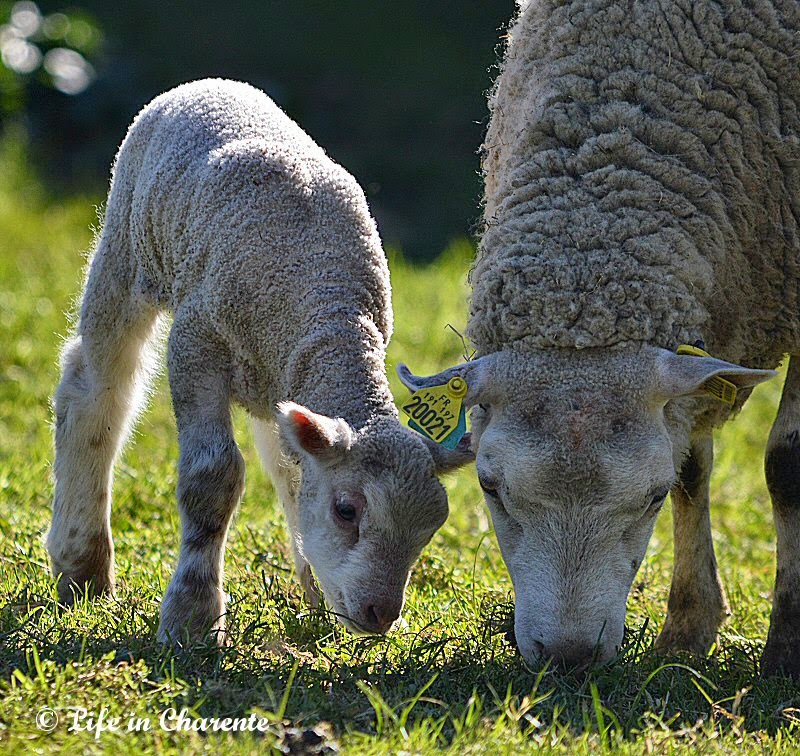
08/03/14 Early lamb

12/04/14 La Rochefoucauld château and its reflection in the river.

12/05/14 Iris.

01/06/14 Humming bird hawk moth.

15/07/14 Common swallowtail.

17/08/14 Cat sitting for our neighbour

17/09/14 Black kite.

26/10/14 Cotoneaster and spider web.

11/11/14 Peacock butterfly

08/12/14 Great tit at the window asking for food!

Happy Christmas 

Gesëende Kersfees

Nginifisela inhlanhla ne mpumelelo e nyakeni

Nadolig Llawen

Nollaig Shona Dhuit

Nollaig Chridheil agus Bliadhna Mhath Ur

Buone Feste Natalizie

Feliz Natal

Feliz Navidad!

God Jul and (Och) Ett Gott Nytt Ar

Kung His Hsin Nien bing Chu Shen Tan

 Gun Tso Sun Tan'Gung Haw Sun

 Kung Ho Hsin Hsi. Ching Chi Shen Tan

Shinnen omedeto. Kurisumasu Omedeto
Sawadee Pee Mai

Gajan Kristnaskon

Froehliche Weihnachten

Kala Christouyenna!

Mo'adim Lesimkha. Chena tova.
Keep well everyone and I will be back in 2015!


Also see my daily diary HERE

and My Life Before Charente (updated 30 October 2014) 

Friday, 11 April 2014

Les Salles Lavauguyon and surrounding area

There is so much of interest here, that I took 61 photos!!; I whittled these down, with the hope that I have picked the best. The village lies just over Charente's eastern border, in the Haute-Vienne, close to the perimeter of a huge crater created by a meteorite 200 million years ago - of which more another time! The settlement has a fascinating more-recent history, as you will see below.

The smaller sign above is written, I suspect, in either the language of Occitan (Oc) or a dialect (Oïl), which was spoken by the peoples of the region in medieval times. Both these words means "yes" in the respective languages, but the latter is now unfortunately reported as becoming extinct.


The very imposing mairie!

A street scene, with village shop, providing groceries and many other useful services, like gas bottles, Wi-Fi, mail box and photocopying! Few of these local businesses have survived supermarket competition, so the villagers have a rare treasure here!

The sign marks a local tourist route, set up to honour Richard the Lionheart (King Richard I of England from 1189 to his death in 1199), who spent much of his time in the region during the latter part of the 12th century as a ruler and commander, notably in the Third Crusade against Saladin. His mother was Eleanor of Aquitaine, the wife of Henry II, and he spoke in the local dialects mentioned above.
The village was also on the pilgrim route to Santiago de Compostela in Spain, so it must have been an important and busy place, with travellers always passing to and fro. 

The church was commenced in 1075 and dedicated to Saint Eutrope, who was a regional bishop, martyred in the 3rd century. It is a striking example of Romanesque architecture, but having unfortunately been sited both on quite a steep slope (as you can see above) and next to a spring, it suffered greatly from damp and a slippery earth floor. This was was only levelled and paved in the 19th century!

Close up of decorative arches and carving over the entrance door


The church underwent major reconstruction in the 12th century when the priory was added. Built to accommodate a chapter of 12 religious men, who were of a status senior to monks, it originally comprised only two rooms, a ground floor communal room (still used today!) and a dormitory above.

The nave and altar

Ancient masonry and stained glass windows

View towards the entrance door.

The following series of photos are of the magnificent 12th century frescoes,  only discovered by accident in 1986, when restoration work required the removal of walling which had been covering them!

The themes, high quality and the richness of their colours make them unique in western Europe.

Panels depict scenes from both the old and new testaments, which include the 'Creation' (Adam and Eve) and the 'Nativity' (Birth of Jesus), as well as illustrations of the vices, greed, violence, vanity and lust, and the brutal death of Saint-Eutrope. Other frescoes on the south and north walls continue the themes with dedications to male and female saints (all of whom where martyrs) and priors.

A side doorway with wall statue

Presumably a font; note how the floor paving has been roughly taken up so as to accommodate the base!

A niche dedicated to Saint Eutrophe, now sadly lacking the effigy

Moving 2 kilometres down the road to the neighbouring hamlet, simply,  but confusingly, called Lavauguyon, where the lavoir, originally providing the village's laundry facility, can be found beside a bridge over this small watercourse.


Lavaugyon is also the site of a 12th century ruined castle, which must have seen action in the times of Richard the Lionheart

It is now slowly being restored by voluntary labour, but I hope they get on with the work before it collapses and disappears for ever!

This looks serious!

The  prominent memorial, sited on a green next to the church, to those of the village who gave their lives in the Great War of 1914-18.


See also My Life Before Charente (updated 30 March)
and my daily blog