Showing posts with label Recipes. Show all posts

Saturday, 9 April 2016

Recipe - White fish with chorizo and ratatouille

I have not put a recipe on this blog for ages, but having experimented with some combinations of our favourite ingredients, I have produced a dish which we think we will often be eating again in the future, so I felt it was worth sharing with you all!


Any white fish should do for this recipe.  The first time I tried it, I used cod, then last night I used whiting, which I filleted first.   Both times we said how good it was. I have all vegetable ingredients either bottled, or in my garden, so it is easy for me!


Ingredients with optional topinambour (jerusalem artichoke) in unpeeled state - see top left insert.

White fish with ratatouille and chorizo.  (for 2 people)

Ingredients
1 tablespoon olive oil.
1 large onion, chopped.
Ratatouille.  Mine is home made and I used about half of the large jar in the picture above - about 500 grams (1lb).
If ratatouille is not available, a tin of tomato pieces would probably do, but the flavour of the dish may suffer.
1 heaped teaspoon light, soft brown sugar.
Several sprigs thyme, leaves stripped. If not available use a teaspoon of dried thyme.
1 tablespoon soy sauce.
60 grams of chorizo (we used hot, but any type will do) Cut the sausage lengthwise and then slice.
Optional - Several pieces of topinambour (jerusalem artichoke) peeled and sliced.
2 pieces of white fish de-boned.

Non stick frying pan with a lid for cooking the meal.

Method
Heat the oil in a frying pan, add the onion, topinambour (if using) and chorizo, then fry for 5-8 mins until the onion is soft. Stir in the ratatouille, sugar, thyme and soy sauce, then bring to the boil.

Simmer 5 mins, and then put the fish on top of the sauce. Cover and gently cook for about 5 mins until the fish is steamed and cooked through.
I served it with mashed butternut (also from the garden last season), but any alternative vegetable of your choice would be acceptable.  

Onion, topinambour and chorizo.

All ingredients except fish cooking for about 5 minutes - per recipe above. 
I forgot to take a photo of the fish steaming with the lid on!!

But here is the final meal served with the butternut mash.


Also see my daily diary HERE

and My Life Before Charente (updated 09 April 2016) 

Tuesday, 20 May 2014

Vegetable casserole.

Firstly I must apologise to you all for the slow rate at which I am posting!
Time just seems to fly by and  keeping up with everything is not easy, especially at this time of year, when the garden needs a lot of attention!  

I have still not managed to edit my photos of the Lot region of France and we go on holiday next month, so there will be loads more photos to edit on our return after 3 weeks of travelling.  I have, however, managed to keep up the photo diary, for those who are interested. Catching up with 'My life in the Charente' in summer may be difficult but I will do my best when we return from holiday.  Tomorrow we have a blogger friend arriving and we are looking forward to showing her around; sadly the weather has taken a turn for the worse and lots of rain is forecast!

Meanwhile, I have discovered an amazing way to make a vegetable casserole and decided to pass on my 'invention,' as we thought it was so good.  No amounts or weight are involved; just decide how much you need for each person.


You could use pretty much any vegetable of your choice but I used:

2 carrots
1 parsnip
A large stick of celery
2 leeks
A few mushrooms
Two sticks of asparagus that I had in the fridge.
Freshly ground pepper to taste

Chop all and put into a dish with a lid.  I then added liquid 3/4 of the way up the dish.  This was a 50:50mix of box orange juice and dry white wine with a vegetable stock jelly added.  Put on the lid and cook in the oven at about 190C (375F, gas mark 5) until the carrot is just tender; mine was done in a little more than an hour. Pouring in heated liquid  first would speed up the cooking time if you were in a hurry.

When the vegetables were cooked, I drained off the liquid to make a sauce and kept the vegetables warm meanwhile. 

Butter - about 60 grams or 2 ounces, melt in a small saucepan then add some flour (about 2 tablespoons), Add a couple of heaped tablespoons of lemon and lime marmalade, stir well then slowly add the vegetable liquid, stirring all the time until you have a thick pouring consistency.  Serve up the vegetables and pour some of the sauce over.


I served it with a potato cooked in the slow cooker, and a grilled pork chop, it was delicious.

Pasta sauce.

We had some of the above vegetables left over, as I had cooked more than we needed. I made up a little more sauce using butter, flour, wine, orange juice and marmalade and adding the left over vegetable.  We then poured it over our favourite pasta and hey presto, what a great sauce it made.

I hope that you get to try this out as I thought it was really exceptional and the lemon and lime marmalade just finished it off with a novel taste.  It may work with any marmalade, but that is for you to try and experiment with!


See also My Life Before Charente (updated 9 March)
and my daily blog

Sunday, 6 April 2014

Afrique du Sud pudding recipe in my French kitchen.

South African ‘Melk Tert'.

Shell:
1 cup plain flour
1 teasp baking powder
¼ cup sugar
2 oz margarine
1 egg

Sieve flour and baking powder; rub in marge until breadcrumb texture. Beat egg and sugar well and add to above. Press into pie dish and prick well. Bake at 200 for 15 minutes.  

N.B. Very important - During cooking, after about 5 mins press the centre down well with spoon. May need pressing down again before finishing.

Filling:


2 Cups milk
1 tablesp margarine
1 teasp vanilla
2 eggs
1 tablesp plain flour
1 tablesp corn flour
½ cup sugar

Cinnamon sugar (to sprinkle over tart when cool)

Beat eggs and sugar well, add flour and corn flour and beat again. Bring milk, vanilla and margarine to the boil, add the egg mixture and put back on the heat stirring all the time until thick. (It burns very easily!)

Pour into shell when slightly cooled. Put in fridge until ready to serve and sprinkle generously with cinnamon sugar. 


The shell mixture is quite sticky and I spread it with a spoon pushing it up at the edges.

Prick well - it rises almost too easily!

Cooked - note flat bottom, the result of pushing down in the centre!

Stirring the filling on a low heat.

All finished, except for the sprinkling of cinnamon sugar.

We love this pudding. Enjoy!!


See also My Life Before Charente (updated 30 March)
and my daily blog


Saturday, 12 October 2013

Too Many Quinces??

This is the easiest way I have discovered to use up as many quinces as I can.  Our tree is laden, and I am picking them by the bucket load.


QUINCE JAM/JELLY
This recipe is so simple, but the  preparation time  in washing and cutting up the quinces is considerable! Don't throw out the liquid from the first boil. Use it to make quince jelly (see below).

This is how I prepare the quinces and through doing so many, I find I have got quite quick at the job now!
A good knife and peeler is very important when dealing with quinces.  Once ripe, mine lose their fluffy coats; if yours are still fluffy, wash them well first.
I cut off the two ends to make peeling easier.
It is then very easy to peel quickly.
Cut off the large pieces from the stone and cut into bite-size pieces for cooking.
Then cut off the smaller bits as well and throw all into the saucepan with water.
PREPARATION:
I use about 14 to 30 quinces at a time.

Wash, peel and remove seeds and any dark patches from the quinces. Cut into small chunks and put into a bowl of water to stop the flesh going dark. Drain and transfer to a pot with water with some lemon juice, just to the top of the quince pieces. Cover and bring to a boil over high heat. Boil for 30 minutes, turn off heat, and leave the pot on the stove for minimum of 30 minutes.  If I am busy, I leave over night!
Drain off liquid into another pot to make quince jelly (see below.)
To make jam, I mashed the fruit with a potato masher, the consistency should be similar to chunky apple sauce. Transfer to a large saucepan; I use jam sugar, add the correct weight of fruit to the directions on the sugar packet and bring to the boil with juice from one orange.  Cook for time stated on the packet and put into sterilised hot jars, put the metal lids on immediately and as the vacuum is formed over the next while, the lids should go "pop".

OR add sugar to taste. We do not like it very sweet, ¾ of a cup is enough for us and 1 bottle of cider or rose wine; I prefer the cider!   Bring to the boil and simmer for about 5 minutes.  I then bottle into hot jars from the oven and seal immediately.   Great for adding to fruit salads or eating just as it is, with crème fraiche or ice cream.  Most of my fruit this year has been bottled this way, as I still have jam from last year!!

QUINCE JELLY (Easy)
Make this recipe with the liquid from quince jam. Because quinces have high pectin content, it will set to a jelly without any additives. 

INGREDIENTS:
2 measures of liquid from the quince jam recipe by quantity (not weight)
1 measure of sugar by quantity (not weight) (I used ordinary sugar for this as the jelly sets so easily)
Juice from one or two lemons. 

PREPARATION:
Strain the liquid into a large saucepan (I use a paper filter in a funnel), stir in sugar and boil over high heat until it is a rich looking colour and about ¾ of the amount you started with; this takes about 40 minutes to 1 hour.  I find that when the colour looks a rich pink/ red, it is ready.  Skim off any foam and pour into hot jars with an airtight lid.   I have only once poured too soon and it did not set.  I poured the liquid  back into the saucepan and boiled it up for another 20 minutes and second time around it was perfect!

I also experimented this year with a cake which was delicious.  I based this recipe on Mary’s recipe at One Perfect Bite see HERE 

DIANE'S QUINCE CAKE

3 large quinces, peeled and each cut into four large pieces, plus the smaller bits off the centre stone.
1 cup sugar
2 tablespoons honey
1 teaspoon ground cinnamon
2/3 cup margarine, softened
4 eggs
1 teaspoon vanilla extract
2 cups all-purpose flour
1 heaped teaspoon bicarbonate of soda

Directions:
1) Put the quince into a saucepan and just cover with water, add cinnamon and honey.  Bring to boil and simmer gently until just tender.   Remove the largest pieces to cool on a plate.  The smaller pieces see 3)*


2) When ready to proceed, preheat oven to 180C. Generously grease or spray a 9 x 5-inch loaf pan. (I lined the bottom of pan with parchment paper and then greased the parchment paper as well)
3) Cream butter and sugar in another bowl until mixture is light and fluffy. Add eggs, one at a time, beating well after each addition. Add vanilla. Combine flour and bicarb and gradually add to creamed mixture and beat until smooth.  *Fold the smaller drained pieces of quince into the batter and mix well.
4) Transfer batter to prepared pan. Push the larger bits of quince slices vertically into batter, spacing them over the cake. Bake for 1½ to 1¾ hours or until a toothpick inserted near centre comes out clean. Cool for 10 minutes before removing from pan to a wire rack. Serve hot or cold. Yield: 8 to 10 servings.

N.B. I covered the cake with cooking paper for the first hour, as I did not want it to burn!

Nice eaten as cake or as a dessert with crème fraiche.  As the cake is quite moist, it will only keep for about a week out of the fridge.

You can see how dark the fruit goes even in water...
As soon as it starts to heat up the fruit will go pale again.
Quince jelly and last years's jam.
Quince fruit ready for eating.

The cake was yummy.

I am now off to the kitchen with yet another large saucepan full of quinces....

Tuesday, 16 April 2013

Recipe: Fish a la Diane

Nigel bought some cabillaud at the supermarket last week, about 750 g (1 1/2 lbs). I wanted a dish that I could make very quickly, with minimum of effort and I came up with the following. I am sure any firm white fish would be perfect for this recipe.

Cabillaud =  Cabillaud and Morue are both forms of cod. Theoretically, 'cabillaud' is used for a mature fish and 'morue' is used for an immature fish, the latter quite often for salting. This is called bacalao (or similar) in Spain and adjacent countries.

Fish a la Diane!

750 gr (26 ozs) cabillaud
About 50 g (2 ozs) butter
2 to 3 cloves of garlic
1 tin of sliced mushrooms ( fresh would probably be better!)
2 chopped onions
2 tablespoons of flour
White wine if the stock needs augmenting!
Frozen peas
Salt and pepper to taste

Put the fish in a saucepan and just cover with water.  Bring to the boil, then turn off heat, put on the lid and allow to stand for 10 minutes.   Drain the fish, keeping the stock, then flake the fish into a casserole dish ( fairly big chunks) making sure there are no bones or skin!

Sauté the onions and the garlic in the butter (also adding the mushrooms, if using fresh towards the end).  Remove from the heat and add the flour and stir in well.  Put back on the heat and, stirring all the time, add the stock until you have a medium thick sauce.  Add mushrooms if tinned and also a handful (or so) of peas and season to taste.  Pour over the fish and cook at 180C for about 15 to 20 minutes.

I also grated some parmigiana over the top; it obviously added a cheesy flavour, but I am not sure this was necessary!

We both thought that this was delicious and I will certainly cook white fish like this again.


Chopped onions and garlic at the back
Cooked flaked fish
Ready to go into the oven.  I am sure I took a photo when it came out of the oven as well, but it seems to have gone AWOL!!
Enjoy.


see my daily photo diary  HERE

and also - My Life Before Charente Updated 016/04/2013


Sunday, 17 March 2013

Portuguese Salt Cod Stew


One night last week, Nigel volunteered to cook dinner and he decided that he wanted to use salt cod, or bacalhau as they call it in Portugal. He had been talking about this dish for several weeks, so when we saw some salt cod in the supermarket, he was well and truly hooked, pun intended! It seems to be widely available and used around the Mediterranean, but we are not sure if it can be bought elsewhere in the world.


Portuguese Salt Cod Stew

Ingredients
500 gram (1 lb) salt cod fillets,
½ to ¾  cup of good quality extra virgin olive oil
Milk
2 large onions
500 gram (1 lb) potatoes
3 eggs, hard boiled and sliced
About 40 pitted black olives
Sea salt and freshly ground black pepper
2 to 3 tablespoons capers

Method
Rinse the fillets well and then soak in water for at least 12 hours, changing the water 3 or 4 times. We left them in the fridge overnight.  Make sure all skin and any bones are removed. After the soaking process, the cod should taste  very slightly salty. If there is no salt taste, you will need to add a little salt back.

Put the cod in a saucepan and just cover with milk, or milk and water mixed, bring to the boil, and allow to simmer for a couple of minutes. Remove the fish and set aside. Do not throw away the liquid that the fish was cooked in.

Parboil the potatoes for 20 minutes, using the liquid from the fish; when cooked but still firm, remove them from the liquid and cut into 1 centimetre (1/4 inch) slices.

Generously coat the base of a large overproof dish with oil, then place a layer of sliced onions followed by a layer of sliced potato.

Break up the fish and place half the fish on top of the potato, pour another generous amount of oil over the fish and sprinkle all with freshly grated pepper. Scatter one tablespoon of capers over the fish then repeat another layer of onions, potatoes, fish, capers and some more olive oil.

Finish off with a layer of onions and potatoes, on the top of this place the sliced hard boiled eggs, the olives and some more oil.

Place in oven 180°C (350°F) and cook, covered, for 40 minutes.
Serve with a salad or vegetables of your choice.
Serves 4

This dish was unusual and quite delicious - the cod has an amazing flavour, heightened by the capers.  We will certainly be buying some more salt cod and I will be taking a night off from the kitchen again :-)

The salt cod  soaking in water


See also - My Life Before Charente Updated 17/03/2013

and my daily photo diary  HERE
http://photodiarydps.blogspot.com 


Sunday, 18 November 2012

Paella

Firstly, Nigel would like to say thank you for all the birthday greetings and good wishes he received from literally all round the world! He is not one for wanting to be in the spotlight and was therefore overwhelmed by all the publicity, but he was most appreciative nevertheless. :-)

A couple of weekends ago, I bought some Mozambican prawns from the seafood trader at the Saturday market.  I got home and then wondered what I was going to do with them!  I decided that paella sounded a good choice, despite being short of some of the ingredients I would usually use.  I found the following around the house.

Ingredients
About 10 cms or 4 inches chorizo, cut into thin slices
110g/4oz pancetta, cut into small dice
2 cloves garlic, finely chopped
1 large onion, finely diced
1 green pepper, diced
1 tsp soft thyme leaves (1/2 teasp dry, if you have not got thyme in the garden)
1 small chilli, chopped
1 cup of rice
1 tsp paprika
1/2 cup dry white wine
About 3 cups of chicken stock, hot
3 chicken breasts, each chopped in large bite size pieces 

2 to 3 fillets of white fish cut into bite size pieces
1 cup of frozen peas 
1 tin chopped tomatoes

2 tablespoons of olive oil and a tablespoon of butter
6 to 8 Large cloves of garlic, separated and peeled
12 prawns, in shells, preferably raw

5 tbsp chopped green parsley
salt and freshly ground black pepper

Method

Heat half the olive oil in a paella dish or heavy-based non stick frying pan. Add the chorizo and pancetta and fry until crisp. Add the garlic, onion and pepper and heat until softened.
 Add the thyme, chilli  and  rice, and stir until all the grains of rice are nicely coated and glossy. Now add the paprika and dry white wine and when it is bubbling, pour in the hot chicken stock, add the chicken pieces and cook for 5-10 minutes.  

Add the pieces of fish fillet. Sprinkle in the peas and chopped tomatoes and continue to cook gently for another 10 minutes.

Note - I always have hot water on hand, in case the rice takes up more liquid than expected, and I just add a little if the ingredients look a bit dry.


Meanwhile, heat the remaining oil  and butter with the garlic cloves in a separate pan and add the prawns. Fry quickly for a minute or two then add them to the paella. 

Scatter the chopped parsley over the paella and serve immediately.

For my usual recipe with all the normal ingredients see Here
Add the chorizo and pancetta
 Add the thyme, chilli  and  rice
Chicken, fish and peas added

Fry the prawns and the garlic
Add the prawns to the main dish and serve.

Bon appétit.  


See also - My Life Before Charente Updated 18/11/12

Sunday, 28 October 2012

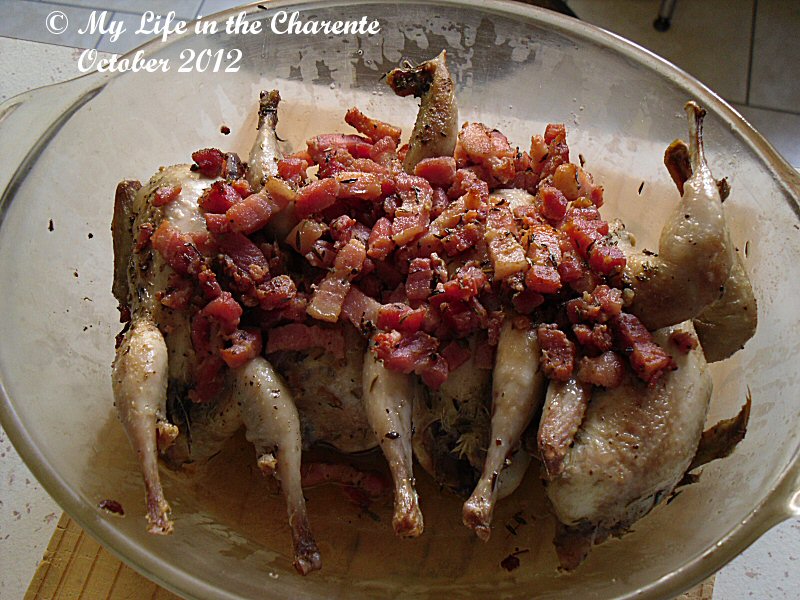
Sunday Night's Dinner - Quail

On Sunday, I surprised Nigel with a meal that is not very common in our household and it was soooooo delicious!!   Sometime ago, I saw quail on special offer in a local supermarket, so I bought some and threw them in the freezer; four of them to be exact!  Last Sunday morning, I thought I would get them out and unfreeze them, then decide what I was going to do with them.  I had a look on the internet and found so many similar recipes, that I decided to get a hint from each one and then do my own thing!


Ready to go in the oven when covered.
Serves 2

4 quails
2 tablespoon quince jelly, but I guess you could use any jelly
100 gr (3½ ozs) lardons or chopped thick bacon
20 pitted prunes
brandy (about 2 liqueur glasses full)
4 shallots chopped chunky
chicken stock cube
water
1 tablespoon thyme (dried)
olive oil
2 tablespoons parsley (dried)
garlic salt
freshly ground pepper.

I put the prunes in a small dish, covered them with the brandy and left them there most of the afternoon to absorb as much as possible.

I cleaned and washed each bird removing the few feathers that were still attached and then sprinkled them with freshly ground pepper and some garlic salt.  I browned them in a non-stick frying pan in a little oil, turning so all sides were lightly browned, I then added the lardons and sprinkled it all with the thyme, I cooked it all for a couple of minutes. I then lined the birds up in a pyrex dish and spooned over the lardons and the thyme. (Keep the pan for later). I popped them into the oven, covered, at 220C (428F) for 15 mins then took them out and let them stand for a couple of hours not removing the lid.  (This step may not be necessary, but I wanted to eat later and I did not want to mess around at the last minute. I suspect though this may have been what made them so tender!)

Just before serving I put the dish back in the oven at 160C (320F) to heat the birds through, while I made the sauce in the non-stick pan.  To do this, heat the pan, add the shallots, fry lightly until glassy in appearance.  Pour over the prunes and the remains of the brandy and flame, lighting carefully with a match.  Add the quince jelly, the chicken stock cube, parsley and a little water  until you have a good sauce consistency, allow to reduce a little.

Remove the quails from the oven, put 2 on a plate and pour the sauce (10 prunes for each person!) over the birds. Serve with vegetables of choice. 


My vegetable selection maybe a bit odd, but I was using up what was plentiful in the garden!  Chard stalks pre-boiled until just soft, then put in the oven with parmesan and pepper sprinkled between each layer with a small drop of red wine, cooked at 180C (356F) until slightly brown. I left them in there when the quail went back in to heat up at 160C.   


The green from the chard was wilted in boiling water, then drained and chopped.  Meanwhile I made a white sauce, added Dijon mustard and freshly ground black pepper to taste,  before I mixed in the chopped chard.  


Chard Stalks
The third vegetable was a very large green tomato that I peeled with a potato peeler. It was firm enough to do this.  I sliced it, and as I layered it in the dish I sprinkled it with pepper and parmesan. It went in the oven, in a separate dish, covered, with the chard stalks and cooked for the same time.

It was very tasty and the quail were remarkably tender.  I was pleasantly surprised that we both felt quite full afterwards.


See also - My Life Before Charente Updated 28/10/12

Sunday, 26 August 2012

An Abundance of Courgettes (Zucchini) and Haricots (Beans)

Despite not feeling quite myself over the past week, (see last post), the garden has been unrelenting in its production of more and more tomatoes, beans and courgettes!!  There were potatoes to be dug as well!! Consequently, the produce needed to be sorted out fairly quickly, otherwise I would have had too much to cope with if the harvesting and preservation fell behind!. I guess the bottling process distracts me from the shingles!!  For many great ideas for surplus courgettes, see HERE .This is a great link with masses of ideas. 

I am, however, very thankful that my  efforts over the growing season have been so well rewarded with loads of vegetables, over a spring and summer of very difficult and extreme weather conditions.

Because I have only a small deep freeze, the easy "freezing" way out was not available to me, so I have been bottling more and more!!  Thankfully, I had a good supply of jars, with plenty still in reserve  for vegetables still to come.

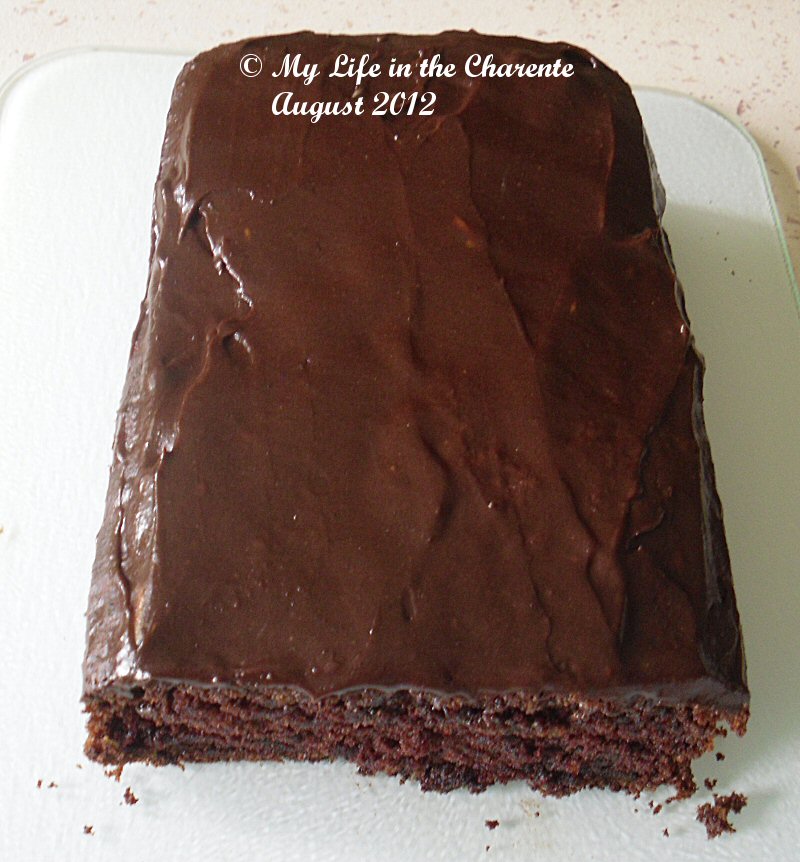
Because we have had carpenters in (lots of noise and another post), I have been making courgette cake (two kinds) as an accompaniment to their numerous cups of coffee.  Both recipes were very popular and the suggestion was that while the courgettes last, they might just move in!!  As the recipes are on my cookery site and I am feeling a bit lazy, I will give you the links for these recipes, so you can follow them there if they take your fancy.


Back to the pickled beans ......  I brought the pickling liquid mixture, left from the courgettes, to the boil,  and added the haricot beans, washed, top and tailed and cut in half. The mixture was then brought back to the boil and bottled immediately. In France, these beans are called haricots verts, but  you would probably know them as French green beans. 

I experimented with this last year and the result, although I say it myself, was fantastic!  The beans seem to shrink a little in the bottle, but when we came to eat them, I simply put the drained beans in fresh water and brought them to the boil.  Drain and serve hot; they were delicious and slightly crunchy, just how we love them. You could probably just make up the pickle mixture for the beans alone, but I have always used it for the two recipes - courgettes and beans.

Pickled Beans (see above)


I made these last year and we thoroughly enjoyed them last winter, so I made some more!!!


Finally, I just liked these clouds that were in front of the sun the other evening.


See also - My Life Before Charente updated  August 26 2012