Showing posts with label USA. Show all posts

Friday, 20 January 2017

Part 12 of our holiday - Visiting Bryce and Zion Canyons

Michael and Mary collected us from the Grand Canyon Lodge at 10 am on 3 July 2016 and we said thanks and farewell to Gaelyn, who was busily back into work mode. It is a 4.5 hour drive to Bryce from the Grand Canyon, so we arrived in the early afternoon. Bryce Canyon is a national park in southwestern Utah and is famous for its unique geology, consisting of a series of horseshoe-shaped amphitheatres, carved from the eastern edge of the Paunsaugunt Plateau. There was plenty of time to have a look around the various named features, and to see the sunset across the canyon. Erosion by  weather has shaped the colourful limestone rock strata into bizarre shapes, including slot canyons, windows, fins, and spires called "hoodoos." Bryce Canyon has the largest collection of them in the world!
Just before arriving at Bryce, we drove through this natural red arch.


Arriving at the Canyon National Park entrance.


Our first sighting of hoodoos! Their colour seems to change with the light conditions.

Yet another natural arch with hoodoos over the top.


As you can see, elevation 8,627 feet  (2,630 metres). It's not quite oxygen territory but impressive enough!

A panarama shot across the canyon just before sunset.

Sunset across the amphitheatre at Sunset Point.


On the opposite side of the Lodge complex, we went on the following morning to Sunrise Point. More hoodoos in a very dramatic landscape!
An unending variety of hoodoos.

We left Bryce  after viewing the sunrise and having a good breakfast at Ruby's Inn, just outside the park, and then we headed off to drive through Zion National Park.  We were heading home to Mesquite, but a drive through Zion in South West Utah on the way was a "must see". A  completely different landscape from Bryce, it has steep red cliffs, but as you can see above, there are also some natural caves and arches..

The scenic drive passes right through the primary area of the park and, being the 4th July holiday weekend and a lovely day, there was heavy traffic congestion!  This photo above is of the short tunnel on the scenic drive,  but there is also a long tunnel, completed in 1930, which is  1.8 km (1.1 miles) long and the longest of this type in the U.S.A!

Views taken of Zion landscape from the car..

The view as below without us in the way! How did those rectangular patterns in the rock get there? Odd but spectacular!

A quick stop, so we could take a photo proving that we had actually been there!

Another view of Zion Canyon before heading back to Mesquite....

and another amazing sunset back in the desert landscape there.

There is one more part of this holiday which is our last afternoon in Las Vegas before flying home, but this will now have to be postponed, as it is now less than a week before we leave for Southern Africa.  I will be back in March (I hope) with the final USA blog, followed by some very different African subjects. Not forgetting, of course, our visits, in December to Le Mans (more to it than just a motor racing centre!) and Rouen (with its amazing medieval old town)  still waiting for a write up!  One day I might just catch up!!!


Also see my daily diary HERE


and My Life Before Charente (updated  25 September 2016) I will get back to this eventually!  


Sunday, 11 December 2016

Our year in monthly photos and wishing all my followers all the very best for 2017 and the coming holidays.

We will be away in a few days time to celebrate Christmas in England with my father-in-law. Computers will be staying at home; only the Nexus tablet will be with us for emailing and maybe the odd single photo on the photodiary.  I find  that blogging on this tablet is beyond me, so I hope to resume when back at home early in the New Year!
Three more posts to go yet on our trip to the USA, but meanwhile here are some of my favourite shots from each month this year!

Blue Tit. 18/01/2016

17/02/2016

Gold finch 10/03/16

Bluebells 16/04/2016

Magpie 09/05/2016

Golden Mantled Ground Squirrel 28/06/2016 USA

Meeting Gaelyn and Bill at the Grand Canyon June/July 2016 USA

Scarce Swallowtail 03/08/2016

Bee on the garlic chives 19/09/2016 

Sunset 16/10/2016

Robin.03/11/2016

Amazing roses still on 11/12/2016

Happy Christmas 

Gesëende Kersfees

Nginifisela inhlanhla ne mpumelelo e nyakeni

Nadolig Llawen

Nollaig Shona Dhuit

Nollaig Chridheil agus Bliadhna Mhath Ur

Buone Feste Natalizie

Feliz Natal

Feliz Navidad!

God Jul and (Och) Ett Gott Nytt Ar

Kung His Hsin Nien bing Chu Shen Tan

 Gun Tso Sun Tan'Gung Haw Sun

 Kung Ho Hsin Hsi. Ching Chi Shen Tan

Shinnen omedeto. Kurisumasu Omedeto
Sawadee Pee Mai

Gajan Kristnaskon

Froehliche Weihnachten

Kala Christouyenna

Mo'adim Lesimkha. Chena tova.

Vrolijk Kerstmis en een Gelukkig Nieuw Jaar

See you all in 2017

Thursday, 29 September 2016

Part 6 of our holiday - A few days in Dallas with friends.

We arrived in Dallas to be met by my friend, who I have known since I was 16!  I worked for her father when I left school.  Great excitement for us both!! I have promised that no photos of her or her family would go on the web, but frankly that was the best part of our visit! At other times, she took us to as many interesting places in the city as was possible in the few days we had there.
The striking Margaret Hunt Hill bridge (named after an  heiress and philanthropist) which spans the Trinity River; I can't explain why there were no other cars in view on that June Friday afternoon! Designed by Santiago Calatrava, the world renowned Spanish architect/engineer, the bridge spans 368 metres (1206 feet) and carries six lanes of traffic between the Dallas CBD and the rapidly regenerating west city suburbs. This is the first of three planned bridges and the second one is under construction at present.   .  The total cost of this one was said to be $182 million.

After the last "empty" shot, here is some real Dallas traffic!  Loads of different lanes - I think there were 4 or 5 going our way! You can see the golden glassed twin towers of the Campbell Centre in the background. See more information below.

A closer view of one of the towers. For those of you who remember the '70s TV soap opera Dallas, this was the first Ewing Oil building used in the opening five episodes!

Dallas County Courthouse, built in 1892 of red sandstone with grey rusticated marble facing to the "first floor" (our "ground floor," but that's what it's called in the US -a bit confusing!) and similar accents around windows.  Also known as the Old Red Courthouse, it is now the Old Red Museum, housing local history exhibits. Very elaborate and obviously a demonstration of the oil wealth on which the city is based.A newer courthouse was built nearby in 1966.

Dallas Perot Museum of Nature and Science opened at the end of 2012. Ross Perot, a Texas industrialist, is famous for twice running for US President, in 1992 and 1996. Designed by  Morphosis Architects, the building was conceived as a large cube floating over a landscaped plinth.  It features a 54-foot continuous flow escalator housed within a 150-foot glass casing that extends diagonally outside the building cube. I'm sure the very modern and startling design is popular with many Dallas residents!

Formerly the Texas School Book Repository and without doubt the most infamous building in Dallas, whose sixth floor was the site from which Lee Harvey Oswald assassinated JF Kennedy  in November 1963. The top two floors house a museum featuring the life and times of arguably one of the US's greatest presidents.

Dallas Museum of Art. The fountain offered welcome wafts of cool water vapour to provide some relief from the high 30sC (90sF) temperatures.

Inside,  the spaces are large, calm and restful. The Large seated nude in bronze by the French artist Henry Matisse (1869 – 1954) caught my eye!

Outside in the sheltered garden, a bronze of Eve by another Frenchman, Auguste Rodin, (1840-1917).  

The Whole Foods Market in the northern Dallas suburbs. The city is extremely wealthy and everything for sale appears to be of the highest quality (and price!).

I don't think I've ever seen such cosseted vegetables! Seems a shame to buy something and spoil the immaculate display!

Cheese from all over the world and a display to rival anything we have here, in the country of 400 local cheeses!

Wine.  Naturally we had to pick the section with French wine - but it's not cheap. These bottles start at about $20 each! The store also has huge displays of olives, coffee beans and a fresh soup counter where you can help yourself, to 8 or so different kinds, which you ladle into insulated cups from giant metal churns! This place has everything you could think of!

The nearby North Park 50 Mall.  A very upmarket shopping mall that officially opened 2 July 1965.  They completed a $250 million expansion in 2006. You could buy a handbag for $2,500, and we were told people frequently do, after they've first visited their personal trainer for some exercise at the gym!

A spotless North Park  pedestrian mall with US sized eye-catching models.

France is not forgotten; perfumes and bathing accessories.

Amazing water features are everywhere, with live birds, turtles and all kinds of greenery - such exotic plants and flowers!

Turtle at close quarters.  The animals appear to be very happily located here and are obviously well cared for, swimming around in pristine crystal clear water. Well, that's a quick view of our stay in Dallas - vibrant and energetic, but not a city for those light of wallet!


Also see my daily diary HERE


and My Life Before Charente (updated  25 September 2016)  

Saturday, 17 September 2016

The second of two episodes in our visit to Washington D.C. The Smithsonian Air and Space Museum - Part 5 of our holiday.

Boys of all ages dream of visiting the National Air and Space Museum of the Smithsonian Institution, which is certainly one of the most popular of the vast array of museums in the city!  Laid out on two huge floors in the National Mall, it holds the largest collection of historic aircraft and spacecraft in the world. It was established in 1946 as the National Air Museum and opened in 1976.  There is also a separate annex of 71,000m2 (760,000 sq.ft.) in Virginia, opened in 2003, which houses workshops, archives and items too large to fit into the city centre museum, like the B-29 Enola Gay and an Air France Concorde.

The Wright brothers were pioneers in the design and building of heavier-than-air powered aircraft  and, of course, made the first successful fights in 1903, taking it in turns to pilot their Wright Flyer I. The engine was designed from scratch by their mechanic, and cast in aluminium, to produce 12 horsepower! The  wooden propellers were hand carved, driving the plane to its  longest flight of 260 metres (852 feet) before the plane was flipped over by a wind gust and damaged beyond repair. I think this must be a replica!
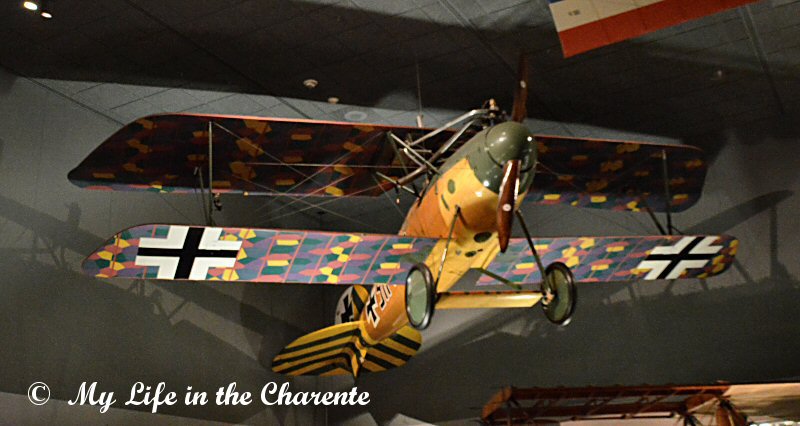
The Albatros D.Va was a  WW1 single-seater fighter aircraft used by the Imperial German Air Service. 1,612 of this version were built before production stopped in early 1918, but the plane continued in operational service until the end of the war.  The earlier models were put into service in November 1916, but many design faults, including wing failures (oops!), caused  Albatros  to respond in 1917 with this final version, which featured a stronger airframe. This modification made the D.Va  heavier,  while failing to cure entirely its structural problems! An uprated Mercedes engine produced 180 horsepower to offset the increased weight of the aircraft, but the celebrated "ace" Manfred von Richthofen was less than complementary about the plane's capabilities!

The Fokker D.VII was another, better designed and more successful, WW 1 fighter. Germany produced around 3,300 of these in the 6 months before the War ended. Interestingly, although first powered by a Mercedes engine which didn't perform very well, the Fokker D.VII was to receive a much more powerful engine from a then fledgling company, BMW - they did well later too! The aircraft was so highly regarded, that the Armistice which ended the war in November 1918 specifically required Germany to surrender all surviving examples to the Allies! These survivors saw continued service with many other countries in the years after WW 1.

The French SPAD (an acronym for a long French company name!) XIII  first flew in April 1917; over 8,000 were built and its Hispano-Suiza engine was made under licence in many Allied countries including the USA, but it proved to be unreliable at first. As time went by, the serviceability was improved and the plane remained in service until 1923.

A mock-up of a German aircraft workshop from about 1918.  I think the engine on the right is the BMW 240 horsepower type used to power the Fokker D.VII above.

After the shocking daylight air-raid on England by the Germans in 1917, the politicians took control.  Responding to the public fear of further attack and desire for revenge, in 1918 they amalgamated the Royal Flying Corps with the Royal Naval Air Service to create the RAF, which was designed not only to protect Britain from aerial attack but to bomb German cities.

The Mitsubishi A6M5 "Zero" is a long-range fighter aircraft and was operated by the Imperial Japanese Navy. More than 10,000 were built between 1939 and 1945. The A6M5  was usually referred to by its pilots as the "Reisen" (zero fighter), "0" being the last digit of the Imperial year 2600 (1940) when it entered service with the Imperial Navy. Well, I never knew that! The Zero was considered the most capable carrier-based fighter in the world, combining excellent manoeuvrability and very long range. This example is believed to be one of 12 captured by the Americans on a Pacific island in 1944.

The Messerschmitt Bf 109, Germany's best known WW II single seat fighter aircraft, formed the backbone of the Luftwaffe's fighter force.  The Bf 109's outstanding performance was demonstrated during the 1936 Olympic Games,  but it first saw military service in 1937, when 24 were shipped to Spain during the Spanish civil war. Equipped with a Daimler-Benz inverted "V" engine, more than 21,000 were built. This particular aircraft was captured from a German pilot who deserted in Italy in 1943 and was then shipped to the US for evaluation.

This amazing shot shows a Boeing B-17 almost leaping out of the painting on the back wall! 
The top plane is a Macchi C.202 Folgore (Lightning), designed in 1940, almost unknown outside Italy, but  the most effective Italian fighter used in WW II.   It achieved excellence handling and speed by using an imported Daimler-Benz engine!
The plane underneath is the North American Aviation P-51 Mustang. It is a long-range single-seat fighter / fighter-bomber used during WW II, the Korean War and other conflicts until it was withdrawn in 1957.  Designed in only 3 months in 1940, and fitted with Rolls Royce supercharged Merlin engines as an upgrade in 1942, it was supremely fast. it is considered the best fighter of that time and was ordered in large quantities by the USAF.

The German V-1, introduced in combat in June 1944 was the world’s first operational cruise missile.  Thousands of pulse-jet powered V-1s, also known as “buzz bombs” were launched against the cities in Britain.  They were slow and inaccurate, and they could be intercepted and shot down. People knew that when they heard the buzzing of the missile stop as its fuel ran out, it was about to drop to the ground and explode, so they sought cover in  underground shelters when they could. The later V-2 was a larger, more formidable vertically launched German rocket, but WW II was almost at an end by the time it was ready for service and thus thankfully little used.

We had problems with so much of Washington being renovated! Here is another example!   Charles Lindbergh completed the first solo nonstop transatlantic flight on May 21, 1927 flying this Ryan Airlines NYP named "Spirit of St. Louis" the 5,810km (3610 miles) between New York and Le Bourget airport near Paris in 33 hours 30 minutes. Lindbergh became a national hero and won a $25,000 prize offered by a New York hotelier. He later gifted the aircraft to this museum.

The Northrop Alpha was an American single-engine, all-metal,   fast mail/passenger transport aircraft used in the first years 1930s.  The Alpha entered service with Transcontinental and; Western Air (the future airline TWA - now defunct!) making its inaugural flight on April 20, 1931. The trip from San Francisco to New York, for example, required 13 stops (wow!) and took just over 23 hours. TWA operated 14 aircraft until 1935, flying routes with stops all over the USA.

In 1947, the US began trying to bridge the gap between manned flight in the atmosphere and space flights. The experimental Bell X-1 flown by Chuck Yeager, to break the sound barrier in that year, is well known. As  development was carried out over the years, the title of world’s fastest and highest flying aircraft fell to the X-15 above.  First flying in 1959, it was lifted to an altitude of 12,000 metres (40,000 ft) by a Boeing B52 bomber.  During the test, it attained an altitude of over 106 km (67 miles) and in 1967 it reached 7,292 km (4,534 mph) 

More US rockets! Left –  the Minuteman III, a missile prepared for training. Centre – Aerobee 150 was first flown in 1955.  Right - Scout-D, which appeared in 1972, was a low cost  launch vehicle for boosting small payloads into low earth orbit. Various models used from 1960 to 1994. You can judge their height by looking at the size of the visitors walking about!

Surveyor was a US project to develop basic techniques for soft landing on the moon to survey for suitable landing sites. Of the 7 launched from 1966 to 1968, five landed successfully and transmitted pictures, sampled lunar soil and performed chemical analyses.   You will remember that the first manned moon landing was in July 1969.

Well, that concludes my two photo galleries of sights we managed to see during our 3 days in DC. If you like museums and memorabilia, you'll certainly have an almost endless supply places to go, but do plan the trip and make sure you have enough time to see what you want to see!


Also see my daily diary HERE


and My Life Before Charente (updated 09 April 2016)  I will get back to this eventually!