
Strasburg, a borough in Lancaster County, Pennsylvania is a haven of peace and tranquility, although less than an hour by car away from the roaring, snarling 8 (other numbers are available!) lane concrete dual carriageway with giant spaghetti intersections forming the monster superhighway Interstate 95, which runs south from the Canadian border, all the way down the east coast to Miami in Florida!
There are lots of photos and information to follow, so, if it all becomes too much, just look at what interests you!

The Pennsylvania Railroad was set up in 1846 and a track network linked the east coast, near here, with the steel town of Pittsburgh far in the west.
The railroad museum was set up on agricultural land in Strasburg in 1975 with the aim of preserving as much as possible of local railway history. It is owned and operated by a State commission and supported by private funding and public donations. The collection comprises over 100 locomotives and carriages, half of which are housed in an indoor exhibition hall of 9,200 m2 (100,000 sq ft). While the vast majority are no longer operable, it is still an enormous thrill to stand next to these, now silenced, giants of early mass transportation and imagine them in action!

Number 1223 above is a 4-4-0 (four leading and four driving wheels) "American" type steam locomotive, the only surviving example of the D16sb class, built in 1905 for the Pennsylvania Railroad by the railroad's own Altoona Works for passenger service. This Workshop at one time employed 16,500 people! In its later life, the locomotive pulled local excursion trains from 1965 until 1989, when it had to be removed from service, needing firebox repairs. Very (too) expensive no doubt!

The 1902 built Class E7s 4-4-2 (but listed as a 4-4-0 for some reason!) locomotive with this number, 7002, allegedly set a land speed record of 127 mph (203 kph) in 1905. When the loco was required to be displayed in 1939 at the New York World's Fair, it was found to have been scrapped (!), so it was decided to rebuild 8063, another of the same class, to look like the scrapped record breaker. It is the only survivor now and, like 1223 above, was gifted to the museum. I just love the cow catcher and headlight!

This "John Bull" is a replica of an 1831 English locomotive, built in 1940 by the local Altoona workshop.

Built in 1939 by Heisler Locomotive Works this 0-8-0 loco named "D" has no boiler or firebox! It was bought by Pennsylvania
Power and Light Company for hauling coal trucks at their power generating plant, after this 95 tonne heavyweight proved too much to bear for the rails at the site of its original owner,the Hammermill Paper Co! Called a fireless steam locomotive, it could carry enough steam in the huge front cylinder for several hours operation. As steam was a by-product of the power generating plant, the loco could easily be refuelled with steam when required, so the concept made economic sense at the time. This unit, displayed in 1940's style livery, was retired from service in 1969.

The G5s was a class of 4-6-0 steam locomotives built in the mid-late 1920s. It was designed to pull passenger trains, particularly on commuter lines, and became a fixture on suburban railroads (notably the Long Island Rail Road) until the mid-1950s. One of three surviving examples, 5741 above was selected in 1979 for preservation and display upon its retirement.

In a post WW2 effort to replace worn-out steam locomotives, two EP20 class passenger diesels were ordered and constructed in 1945 by the Electro-Motive division of General Motors (see, they didn't just make cars!). This surviving locomotive 5901 and her now defunct sister 5900 have the distinction of being the first pair of such locomotives delivered to the Pennsylvania Railroad.

In the late 19th century, logging companies had to solve the problem of moving logs from the forest to the mill as cheaply as possible. Ephram Shay, a timberman, designed his own locomotive, which he hoped would cope with the steep inclines and sharp turns found in forestry areas. In 1880, he took the design to Lima Locomotive Works. The off-centre boiler powered a set of vertical pistons which in turn operated a geared drive shaft to turn the wheels. The design grew and evolved; this is "Leetonia No. 1" from 1906, but between 1880 and 1946, over 2,700 examples of this rather different, but effective, design were produced.

What I would call an "Airstream" style passenger railcar used on local tracks. No detailed commentary was provided around it in this outside siding, but I liked the retro design!

This ginormous 4-8-2, Number 6755 in the M1b class, was another type of loco produced by the aforementioned Altoona Works in 1930. It was used predominantly in freight service, though it would occasionally be used for passenger trains. In 1953, this particular locomotive went back to the Altoona Works and was rebuilt. It continued to be used for freight service, but only for 4 years, when in January 1957, it was retired. Now this grand locomotive stands rather neglected and forlorn in the outside display area. I'm amazed by all those rivets!!

A modern (1939) replica of the John Stevens Steam Wagon from 1825. Stevens built the original locomotive as a concept and ran it on on a small circle of track in Hoboken, New Jersey. He chartered the first railroad in Pennsylvania in 1823, though it was never constructed! The boiler and safety valve of the original machine are now in the Museum of American History.

Built in 1918 by Heisler for the Chicago Mill and Lumber Co, No 4 is another geared locomotive along the lines of the Leetonia above. Despite its more diminutive size, it weighed about 50 tons! It was the first locomotive purchased in 1966 for display at the museum.

Built in 1883 by Baldwin, this sweet little Olomana is a 3 ft (914 mm) narrow gauge 0-4-2 saddle tank locomotive, used in sugar cane harvesting. Not used since 1977, it is on loan from the Smithsonian Institution in Washington DC. It was the third self-propelled vehicle to operate in Hawaii - well that's always good to know!

Built by Juniata in 1916, 1670 was one of the first B6sb class 0-6-0 engines built with some of the emerging new and improved design features available at that time. It toiled in freight yards until October 15, 1957, one of the last steam engines to be retired.

And now for something completely different! The Amish (or Pennsylvania Dutch) people, from European roots, have long been settled in this area, co-existing with modern society whilst quietly pursuing their own simpler, devoutly religious, family-centred and community based way of life, as it would have existed hundreds of years ago. The "old Amish order" do not allow electricity in their homes and do not drive cars. One would think this philosophy would have died out, but in fact, the Amish population has nearly TRIPLED since 1960 and while the tourist industry must provide a good source of income, they discourage too close contact with the modern world. They dislike being photographed and prefer farming to provide for their requirements. Their transportation is by means of horse-drawn carriages, buggies and carts, although sometime you may see much more modern farm equipment pulled by horses!

Horses shaded from the hot summer sun and carriages awaiting passengers for tourist trips.
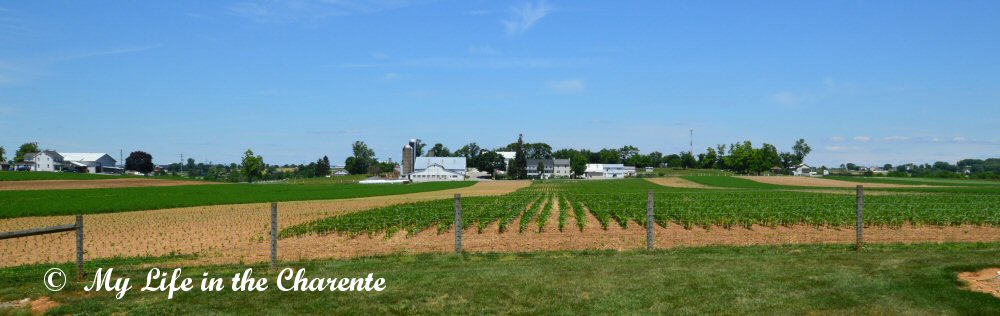
Immaculately manicured Amish farmland. Much work is done by hand!

A goat and an Alpaca in a kids' entertainment enclosure.
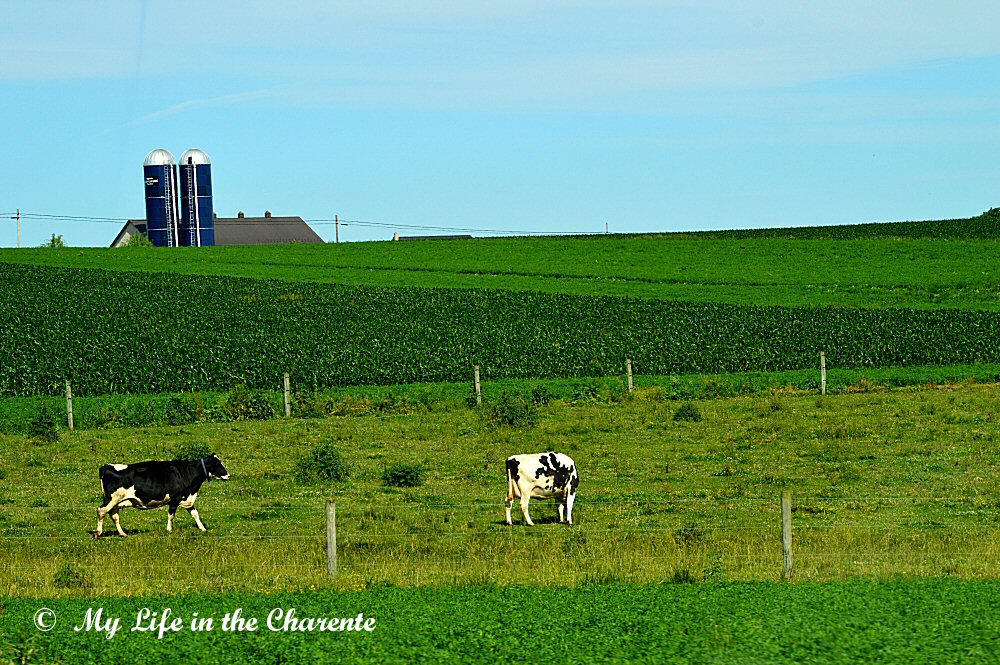
To finish, green, green, Amish farmland! I wonder if they use fertiliser? Probably not!
Thanks Nigel for all your research.
Also see my daily diary HERE
